Inside the Marina Mall Riyadh Project: A Finishing Case Study
Ashlaar Technical Team · September 21, 2026
Marina Mall in Riyadh is a commercial retail development where Ashlaar was engaged as finishing contractor for the owner, Sheikh Magrin Abdul Mohsin. That role is worth being precise about: Ashlaar was not the shell-and-core or main contractor on this project — we were responsible for the finishing programme that turns a structurally complete retail building into the space customers, tenants and the owner actually experience every day the mall is open. For a mall, that distinction matters more than it does for most other building types. A retail mall is judged on day one, in a way office buildings rarely are: shoppers, tenants and the wider market form an impression of the development within the first visit, based almost entirely on the quality of the finishes they can see and touch — the flooring underfoot, the finish on the columns and walls, the decorative work in the entrances and atria. The structural and MEP work behind it, however necessary, is invisible to that judgment; nobody walking through a finished mall is thinking about the concrete frame or the ductwork above the ceiling, but everybody notices whether the floor underfoot is level, well matched and well maintained. It is worth remembering, too, that a mall's finishing has to work for two audiences at once — the shoppers who judge it on sight, and the tenants who judge it on whether it will hold up under the daily reality of running a retail unit for years, which is a higher bar than looking good on an opening-day walkthrough.
Decorative porcelain flooring at mall scale is a different discipline than a standard tiled floor, and it was the anchor of Ashlaar's scope at Marina Mall alongside interior finishing and decorative works. A retail floor has to survive a different kind of life than a residential one: constant foot traffic, trolleys, cleaning equipment, and the general wear of a building that is occupied for long hours every day, for years, without the option of closing a section for repair without a real commercial cost to tenants trading in the units around it. That means the flooring has to be durable as well as presentable, which starts well before the tile is laid — with substrate preparation and screeding that is flat and consistent enough, across genuinely large open floor plates, that the finished surface does not lip, crack or drum under rolling loads. It also means selecting a porcelain body with the wear and slip-resistance characteristics a high-traffic public floor actually needs, not just the appearance a showroom sample suggests, and grouting and sealing it in a way that holds up to repeated cleaning rather than discolouring within the first year. Getting that substrate work right, at scale, is a less visible but more technically demanding part of the job than the tiling itself. It is also a coordination problem as much as a technical one, since the screeding and substrate crews are usually a different team from the tile installers, and the two have to hand off to each other in a sequence tight enough that neither is waiting idle nor working over ground that is not actually ready.
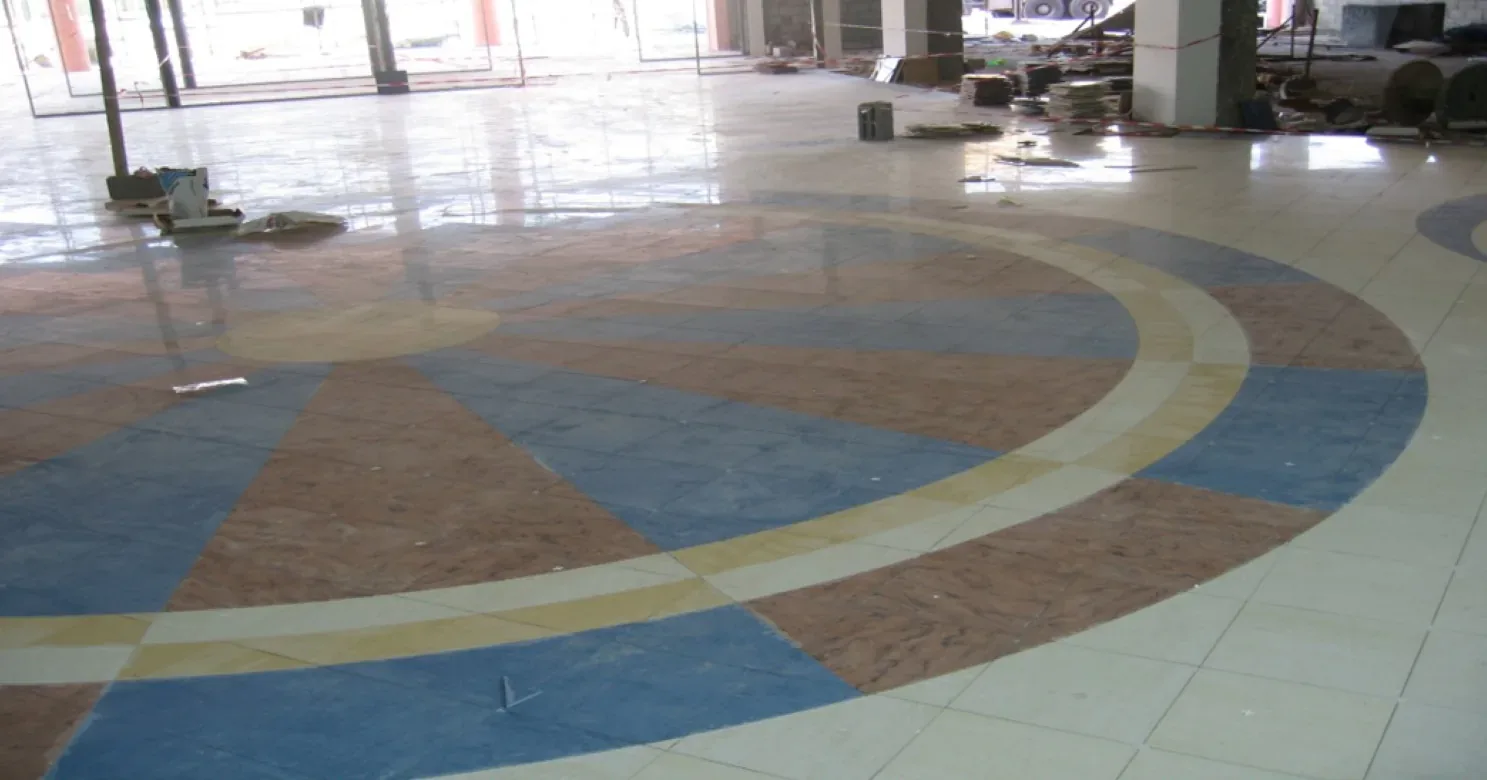
The floor's centrepiece is a large radiating medallion — a compass-style pattern cut from porcelain tile in contrasting tones, set into the main circulation area — and that kind of pattern is a setting-out problem before it is an installation one. Every segment radiating from the centre point has to be cut at the correct angle and length so the points meet cleanly at the medallion's border and the joint lines read as straight from every direction a shopper actually approaches from, which means the whole pattern is chalk-lined and dry-laid on the slab before a single piece is fixed permanently — exactly the check-before-you-cut discipline visible in the tile-cutting work itself. Batch and shade consistency across the contrasting tones matters too, since porcelain is produced and boxed in dye-lots that can vary slightly run to run, so the tiles for each colour band in the pattern are drawn from coordinated batches rather than mixed as boxes happen to be opened. Cutting corners on that discipline is one of the more common ways a patterned floor ends up looking slightly off in daylight even though every individual tile passed inspection on its own.
Three scope lines, one coordinated programme, is a reasonable way to describe how the work actually came together. Porcelain flooring set the technical and visual baseline across the mall's public areas. Interior finishing covered the broader envelope of surfaces and details — walls, columns, ceilings and the general fit and finish of the spaces tenants and the public would occupy — brought to a standard consistent with a flagship retail development rather than a purely functional commercial shed. Decorative works added the elements that give a mall its identity: the feature flooring patterns, borders and inlay work concentrated in entrances, atria and circulation nodes, which is where shoppers form their first and most lasting impression of the development. None of these three lines works well in isolation — flooring that is technically sound but visually inconsistent with the decorative scheme around it looks as unfinished as decorative work sitting on a substandard base, and interior finishing that does not line up with either makes a space look like two different buildings stitched together. So sequencing and coordination between the three lines was as much a part of the scope as any one material, which is really a project-management responsibility as much as a technical one. Getting that coordination right is less about any single decision and more about a steady rhythm of checking — walking each completed section against the drawings and the sections next to it before moving on, rather than discovering a mismatch only once a much larger area has already been finished.
The discipline in a project like this is in the sequencing, not just the material selection. Finishing work on a large retail floor plate has to follow behind structural completion, MEP rough-in and ceiling works without simply waiting for the entire building to be ready, because a mall's opening timeline rarely allows for finishing to start only once every other trade has fully vacated the site. That means working in coordinated zones, agreeing handover points with the other trades active on site, and running quality control at each stage — material batch consistency, level and flatness checks, joint and expansion treatment — rather than only at final inspection, when a problem is far more expensive to fix and far more disruptive to correct around finished neighbouring areas. It also means a supervision presence that is actually on site through that sequencing, not just reviewing progress photos or weekly reports, which is the same principle behind Ashlaar's broader approach to keeping a dedicated engineering team on site daily and reporting progress against the programme every week rather than only at major milestones, so that a sequencing conflict gets resolved in days rather than discovered at the next scheduled meeting. That is also where a finishing contractor's relationship with the other trades on site matters in practice, not just on paper — a supervision team that other contractors are used to coordinating with tends to get faster, more cooperative handovers than one negotiating access for the first time midway through the programme.
Decorative work is where finishing stops being a purely technical exercise and becomes craft. The inlay bands, medallions and pattern work concentrated in Marina Mall's entrances and circulation areas require a different kind of precision than laying a uniform field of tiles — matching tone and cut angle across the radiating pieces, setting out geometric patterns so they read correctly from the angles shoppers actually walk and stand at, and holding tolerances tight enough that a decorative border stays crisp rather than blurring at the joints. This is slower, more labour-intensive work than standard flooring, measured in the number of pieces an experienced installer can set correctly in a day rather than the square metres a standard floor crew can cover, and it rewards patience and an experienced hand more than it rewards speed. It is also the part of the finishing scope most exposed to scrutiny, because decorative flooring sits in the highest-traffic, highest-visibility parts of a mall — the entrance a shopper crosses before reaching a single shop front — which is exactly where the owner, tenants and the public are least forgiving of inconsistency. Training and experience matter more here than anywhere else in the scope, because a decorative installer's judgement about where to centre a pattern, how to handle an awkward corner, or when a piece genuinely does not meet the standard is not something a specification document can fully substitute for.
Protecting finished work is its own discipline on an active retail site, and it mattered throughout the later stages of this project. A mall fit-out is rarely a single-contractor environment by the time finishing nears completion — tenant fit-out teams, MEP commissioning crews and other trades are typically still moving through the building, which means newly laid porcelain flooring and completed decorative work need genuine physical protection, not just careful installation, to survive the remaining construction traffic undamaged. That includes practical measures like temporary protective boarding on completed floor areas, clearly marked and controlled access routes for trades still working nearby, and sequencing remaining trades away from finished zones wherever the programme allows, followed by a proper inspection and snagging process before any area is considered handed over. Skipping that discipline is a common way for finishing work that was executed well to end up looking poor at opening simply because it was not protected through the last stretch of the programme — a scratched or chipped tile at a ribbon-cutting is rarely a material failure, it is almost always a protection failure. The cost of that protection is small compared with the cost of remedial work on a finished decorative floor, which typically means lifting and relaying cut pieces in a space that is, by that stage of the programme, already surrounded by other completed work that then also needs protecting during the repair.
What the project shows, honestly, is a straightforward case of finishing contracting executed to the standard a flagship retail development requires: durable, consistent porcelain flooring — including a precisely cut decorative medallion — across large public floor plates, interior finishing brought to a presentable commercial standard, and decorative work detailed carefully enough to hold up under the close, repeated scrutiny that a mall's public areas receive every day it is open. Ashlaar's role was specific — finishing contractor, not main contractor — and the value delivered sits squarely within that scope: a retail environment that reads, on the shopper's first visit and the thousandth, as the quality of development the owner intended, without the flooring, walls or decorative details drawing attention to themselves for the wrong reasons. That is the outcome Marina Mall was delivered to, and it is the same standard of work — durable, well-sequenced, quality-controlled architectural finishing — that Ashlaar brings to commercial developments across the Kingdom, whether the scope is a full turnkey fit-out or, as here, a focused finishing contract inside a larger project team. It is also, in a smaller way, a demonstration of what "finishing contractor" actually means on a project of this scale — not a single trade applied at the end, but a coordinated programme of materials, sequencing, craft and protection that has to hold together from the first screed to the last inspection.
Related capabilities
Related projects
CommercialPlanning a project? Let's talk finishing.
Tell us about your scope and timeline — our technical team will respond with a clear, considered proposal.